
| Why Most Software Projects Fail (And How the Right Tech Stack Prevents It) |
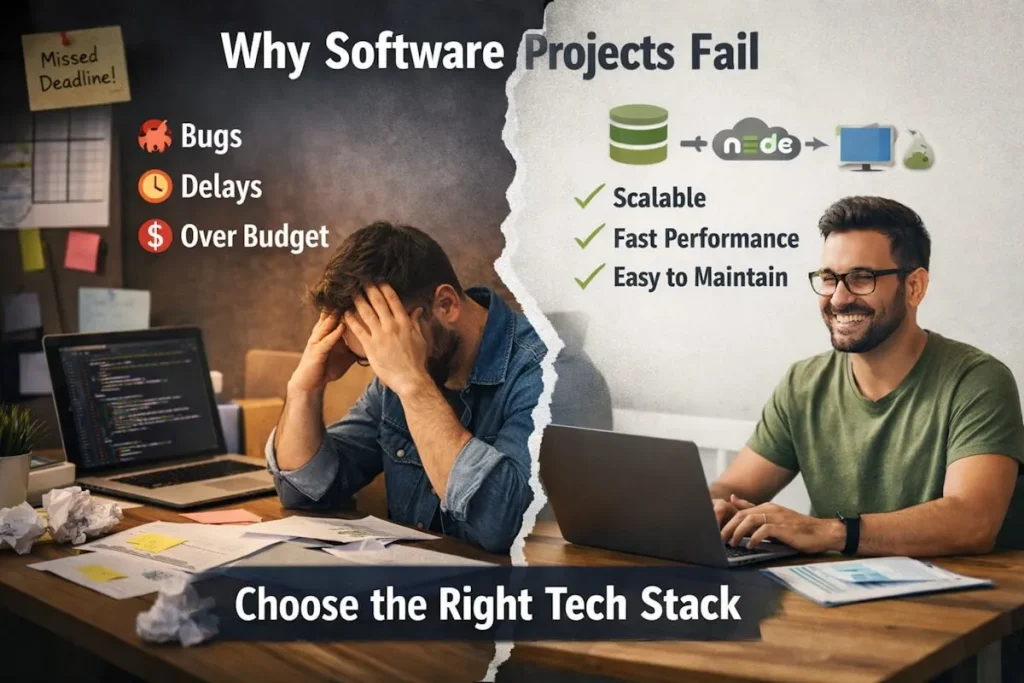
Software projects don’t usually fail overnight. It’s rarely one big mistake. It’s a slow buildup of small decisions that seemed fine at the time. Deadlines slip. Budgets stretch. Teams get frustrated. And somewhere along the way, the original idea loses its shape.
You’ve probably seen it happen. Maybe you’ve even been part of it.
So what actually goes wrong?
And more importantly, how does choosing the right tech stack change the outcome?
Let’s break it down.
The Reality Behind Software Project Failures
A lot of people assume failure comes from poor coding. That’s part of it, sure. But the real issues usually start much earlier.
Think about unclear requirements. You begin with a rough idea, then keep adding features. No one really defines what “done” looks like. The project keeps stretching.
Then there’s communication. Developers, designers, and stakeholders often speak different languages. Not literally, but in how they think. One wants speed. Another wants perfection. Someone else wants quick results for a demo next week.
Now add unrealistic timelines. Everyone agrees to ambitious deadlines just to get started. But once development begins, reality kicks in.
And here’s the big one people overlook. The tech stack.
What Is a Tech Stack, Really?
A tech stack is simply the combination of tools, frameworks, and technologies used to build your software.
Frontend, backend, database, APIs, hosting. Everything working together.
Sounds straightforward, right?
But here’s where things get tricky. The wrong stack doesn’t always fail immediately. It slows you down. Quietly.
Common Reasons Software Projects Fail
Let’s talk specifics. These are patterns that show up again and again.
1. Poor Planning from Day One
Some teams jump straight into development. No roadmap. No structured thinking.
It feels productive at first. Code is being written. Progress looks visible.
But then problems start piling up. Features don’t connect properly. Refactoring becomes constant. You end up rebuilding parts of the system multiple times.
2. Choosing Technology Based on Trends
This happens more than you’d think.
A framework becomes popular. Everyone’s talking about it. So teams decide to use it without asking a simple question.
Is this right for our project?
Just because something is trending doesn’t mean it fits your use case.
3. Lack of Scalability Planning
Early versions of a product might work fine. Small user base. Limited data.
But what happens when traffic grows?
If your stack isn’t built to scale, things break. Slow performance. Crashes. Frustrated users.
And fixing scalability later is way harder than planning for it early.
4. Difficulty in Hiring and Maintenance
Some technologies look great on paper but are hard to work with.
If your stack requires highly specialized developers, hiring becomes tough. Costs go up. Development slows down.
Maintenance becomes another headache.
5. Poor Performance and Speed
Users don’t wait. If your app is slow, they leave.
The wrong backend setup or inefficient architecture can lead to delays in response time. That directly affects user experience.
And once users lose trust, it’s hard to get them back.
How the Right Tech Stack Changes Everything
Now let’s flip the script.
A well-chosen tech stack doesn’t just support your project. It makes everything smoother.
Development becomes faster. Teams collaborate better. Scaling feels manageable instead of stressful.
So what does “right” actually mean here?
It Matches Your Project Goals
Are you building a real-time app? A content platform? An enterprise system?
Different goals need different tools.
For example, if your application requires handling multiple requests at once without slowing down, using something like Node.js makes sense. That’s where NodeJS Development Services come into play. They help build applications that handle high concurrency without breaking a sweat.
It Supports Scalability Early On
A good stack doesn’t just work for today. It prepares you for growth.
You don’t want to rebuild your entire system when your user base increases.
With the right setup, scaling becomes an extension, not a crisis.
It Speeds Up Development
Time matters. Especially if you’re trying to launch fast.
Using the right frameworks and tools reduces development time. Reusable components. Better libraries. Faster testing cycles.
Everything moves quicker.
It Makes Hiring Easier
If your tech stack is widely adopted, finding developers becomes easier.
That’s why many businesses prefer to Hire Node Developers. The ecosystem is large. Talent is accessible. And onboarding is smoother.
You don’t get stuck waiting months to fill a position.
It Keeps Maintenance Manageable
Software isn’t a one-time build. It needs updates, fixes, and improvements.
A clean, well-supported stack reduces long-term headaches. Your team can focus on growth instead of constantly fixing issues.
Why Node.js Stands Out for Modern Projects
Let’s talk about a practical example.
Node.js has become a popular choice for many types of applications. And there’s a reason for that.
It handles asynchronous operations really well. That means it can process multiple tasks at once without slowing down.
For applications like chat platforms, streaming services, or real-time dashboards, this matters a lot.
It also uses JavaScript on both frontend and backend. That simplifies development. Teams don’t have to juggle multiple languages.
And the ecosystem is huge. Libraries, tools, community support. Everything you need is already there.
This is why many companies lean toward NodeJS Development Services when they want flexibility and speed.
Signs You’ve Chosen the Wrong Tech Stack
Not sure if your current setup is holding you back?
Here are some red flags.
- Development feels slower than expected
- Frequent bugs and performance issues
- Difficulty scaling when users increase
- High dependency on a few developers
- Constant need for rework
If you’re nodding your head to more than one of these, it might be time to rethink your approach.
How to Choose the Right Tech Stack for Your Project
This doesn’t have to be complicated. Just ask the right questions.
What are your project requirements?
Start simple. What are you building? What features matter most?
Don’t overcomplicate this step.
What’s your expected scale?
Think ahead. Not just for launch, but for growth.
Even if you start small, your stack should handle expansion.
What’s your budget?
Some technologies are more cost-effective than others.
Balance performance with practicality.
How easy is it to find developers?
A great stack is useless if you can’t build a team around it.
Keep hiring in mind.
How strong is the community support?
Active communities mean better resources, quicker problem-solving, and long-term stability.
The Bigger Picture You Shouldn’t Ignore
At the end of the day, technology is just one part of the puzzle.
But it’s a big one.
The right tech stack supports your vision. It removes friction. It allows your team to focus on building, not struggling.
Ignore it, and you’ll feel the impact sooner or later.
Wrapping It Up Without Overthinking
Software project failure isn’t random. It follows patterns.
Poor planning. Wrong decisions early on. And yes, choosing the wrong tech stack.
But the good news? These problems are preventable.
If you take the time to choose wisely, align your tools with your goals, and build with the future in mind, you’re already ahead of most teams.
So before you start your next project, ask yourself one thing.
Is your tech stack helping you move forward, or quietly holding you back?